
Greece Accelerates Transition to Renewable Energy
Greece achieves record clean energy production, sets ambitious targets for 2030 and beyond while emerging as a net electricity exporter.
Publish Date: Fri, Sep 19, 2025 10:47 AM UTC
Greece Accelerates Transition to Renewable Energy
Greece achieves record clean energy production, sets ambitious targets for 2030 and beyond while emerging as a net electricity exporter.
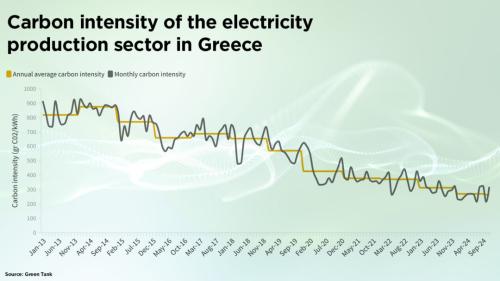
In recent years, Greece has achieved remarkable progress in renewable energy, reaching its highest level of clean energy production in a decade. According to the think tank Green Tank, renewables and large hydro now cover more than half of national electricity demand, highlighting the country’s steady path toward carbon neutrality by 2050 and its ambition to become a green energy hub in Southeast Europe.
Under the revised National Energy and Climate Plan (2025–2050), Greece targets a 58% cut in greenhouse gas emissions within five years, an 80% cut by the mid-2030s, and full carbon neutrality and energy independence by 2050. To meet these goals, the share of renewables in electricity production is set to climb from today’s 57% to 75% by 2030 and nearly 96% by 2035. Achieving this will require €436 billion in combined investments, expected to add €6 billion annually to the economy and boost GDP by 2.5% by mid-century.
Recent data from the Independent Power Transmission Operator (ADMIE) shows that renewable electricity output (excluding large hydro) more than doubled between 2019 and 2024, growing at an average rate of 15.6% per year. This surge in capacity, combined with the government’s decarbonization policy, has fundamentally changed the country’s energy mix. For the first time since 2000, Greece became a net electricity exporter in 2024, a major milestone for energy security.
Investments in solar, wind, and supporting infrastructure have exceeded €9.5 billion in just five years. By 2024, renewables covered 55.3% of demand in the interconnected system—up from 51.4% the year before—while the use of lignite declined sharply. Deputy Energy Minister Nikos Tsafos recently noted that around 13 GW of solar and wind installations are now in place, placing Greece above the European average for renewable penetration and ranking it 7th among 36 European countries in renewable growth between 2014 and 2023.
Despite this progress, challenges remain. On non-interconnected islands, fossil fuels still dominate electricity production, and the rapid expansion of renewables is creating technical hurdles for grid management. Even so, the overall trajectory is clear: Greece is steadily reducing dependence on both coal and imported energy, while building one of Europe’s fastest-growing green energy sectors.